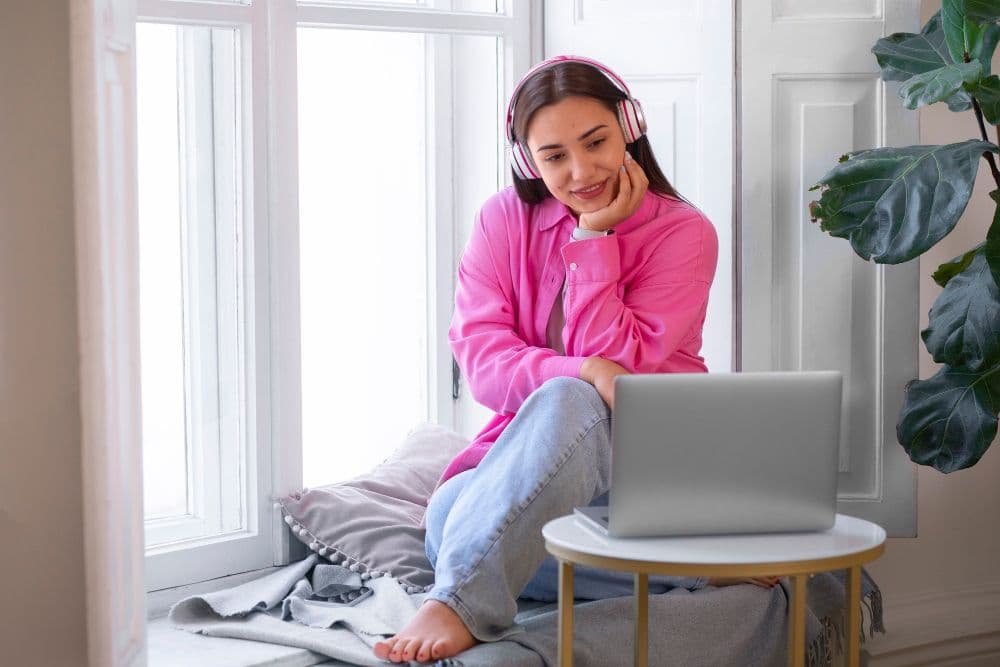
Imagine this: You’re sitting on your couch on a Saturday afternoon, legs sprawled out, a cosy blanket around your shoulders and a warm cup of coffee in your hands. But no, you’re not binge-watching Netflix, you’re attending an online counselling session!
Does that sound like a dream? We’re here to remind you that it’s a very easily accessible reality! Online counselling is becoming a popular choice of mental health support among Australians, especially after the COVID-19 pandemic.
However, if you’re still feeling sceptical about online counselling and whether it’s the right choice for you, you’re at the right place. Our blog explores the pros and cons of online counselling, along with many frequently asked questions such as ‘Is online counselling effective?’ and ‘Online counselling vs in-person counselling - which should I choose?’.
When you’re just starting out with therapy and weighing out different options, it’s perfectly normal to ponder the question ‘Is online counselling effective?’
Can online counselling match the experience and impact of in-person counselling? The good news is that research has consistently answered yes to this question. Online counselling is proven to be just as effective as face-to-face counselling and, in some cases, also comes with added benefits.
Here’s a quick look at what studies say about online counselling and its effectiveness:
A randomised controlled study comparing online and face-to-face psychodynamic counselling for university students found that both methods significantly reduced levels of depression, anxiety, obsessive-compulsive symptoms, and interpersonal sensitivity. While face-to-face therapy showed a slightly higher impact on overall life satisfaction, the online counselling still demonstrated strong effectiveness in reducing psychological distress.
A systematic review and meta-analysis of telehealth interventions found that online counselling has the same effectiveness as in-person therapy for treating anxiety disorders. No significant differences were found across multiple follow-up time points, ie immediately after treatment, at 3 months, 6 months, and even 12 months.
A study in the Journal of Affective Disorders found that online counselling is as effective as face-to-face counselling for treating depression.
A 2018 study published in the Journal of Psychological Disorders found online CBT as effective as in-person CBT for major depression, panic disorder, social anxiety disorder, and Generalised Anxiety Disorder (GAD).
According to a 2020 study published by the Journal of American College Health, online Solution-Focused Brief Therapy is just as effective as face-to-face or in-person counselling in reducing anxiety.
Now that we’ve looked at the research backing the effectiveness of online counselling, let’s start exploring the pros and cons of online counselling in depth.
You’ve read the research: online counselling can be just as effective as face-to-face counselling. But here’s the main question: is it the right fit for you and your needs? Instead of a generic pros and cons table, we bring you a detailed section exploring when online counselling is a great fit and when it may not be.
Are you someone who likes having a lot of freedom, balance and flexibility in your daily schedule, or someone with caregiving responsibilities? If so, here’s why online counselling could be just the thing for you:
All you have to do for an online counselling session is this: block an hour in your schedule, pick out a private space and check your internet connectivity and device.
Where do most people feel at home? The answer lies right in the question – at home!
Online counselling offers the unique benefit of accessing professional mental health support right from the comfort of your home (or any other place you feel safe attending from).
When you’re at a familiar place such as your home, your nervous system feels calm, safe and grounded, allowing you to open up to your online counsellor more easily.
Therapeutic outcomes are directly linked to how much you trust your counsellor and how honest you’re able to be with them. Online counselling increases these odds in your favour by giving you a head start!
Living outside major cities or travelling frequently can make it challenging to engage in in-person counselling consistently.
Online counselling is the perfect choice for you if you live in a place without many counsellors or if you travel a lot (for work, school or otherwise).
With online counselling, you no longer have to factor in such geographical restrictions and can connect with counsellors from all over the world.
Another scenario where online counselling becomes ideal is when you relocate to another city or country. In such cases, online counselling provides continuity of care by allowing you to see the same counsellor, even if you’re in different locations.
Specific physical and mental health challenges may limit mobility and thus the ease of attending in-person counselling sessions. These can include disabilities, chronic health conditions, as well as mental health issues like agoraphobia and severe social anxiety or Obsessive Compulsive Disorder (OCD).
Online counselling is a much-needed avenue for those dealing with such conditions. It allows them all the benefits and effects of counselling while avoiding the difficulties of physical travel and numerous social interactions. It can also be an easier starting option for those with a fear of starting counselling.
Some of us don’t enjoy travelling frequently, and that’s perfectly alright! Travel comes with a lot of stressors such as noise, unwanted social interactions, planning, logistics, traffic and crowds. And not all of us are especially keen to experience them.
If that sounds like you, we encourage you to try online counselling in Australia. Online counsellors provide a safe and comfortable therapeutic space that you can access without the hassles of travelling to a physical location.

Online counselling works best when you’re calm, collected and feel safe in a private space.
For those living with family, friends or roommates, finding a private space where you won’t be disturbed for at least an hour can be difficult. Even if someone won’t walk into the room, you may have disturbances like loud noise or chatter.
In some cases, you may wish not to share the fact that you’re engaging in therapy with others (eg, if you don't have a healthy relationship with your mom). But you can still make online counselling work. Here’s how:
Inform your roommates or family members not to disturb you for an hour (if you wish not to disclose what you’ll be doing, try keeping it vague or use another reason you’re comfortable with).
Plan to attend online counselling on days when your roommate or family members will not be around.
You can even attend online counselling sessions from quiet cafes (with private booths), meeting rooms at your workplace or even your car.

As humans, we depend a lot on non-verbal cues. In addition to this, many find it easier to bond or connect with people in person vs online.
If you’re someone who highly prefers having face-to-face interactions and depends a lot on non-verbal cues like body language, online counselling may not be the best fit for you.
But you can still make online counselling work. Here’s how:
Choose video-based online counselling as opposed to audio or text-based counselling.
Ensure you have proper lighting in your room and check your internet connectivity ( buffering or lagging videos can make it harder for you to read non-verbal cues).
Use a device with a larger screen so that you feel like you’re actually looking at your therapist as you talk to them.
Talk to your online counsellor about your apprehensions – this can help them check in with you regularly and take other measures to strengthen your sense of connection and comfort.
Let’s face it – internet connectivity has a mind of its own. Sometimes it’s so strong you can binge four movies in a row (without a moment of buffering), but other times, it takes ten minutes to send a text message.
An unreliable internet connection can be one of the trickiest parts to navigate when it comes to online counselling. No one wants to be cut off in the middle of a deep conversation with their counsellor.
In addition to this, other tech-related aspects, such as device battery, unexpected resets, or screen freezes, can also add to the stress.
But here’s the good news: these situations can be easily avoided or worked around. Here’s how:
Check and recheck your internet connection well before your online counselling session (say, a few hours before).
If you find your network to be generally unreliable, consider upgrading your internet package or shifting to a different internet service provider (talk to others in your area to see which ISP works best there).
If your mobile hotspot is strong and reliable, consider connecting to that for the duration of your online counselling sessions.
Charge your device battery to 100% and keep your charger handy to plug in during the session (if needed).
Make sure all necessary updates are up to date or scheduled for after the online counselling session.
Use a device that is fairly reliable and doesn’t have a history of freezing or blacking out suddenly. If your device does this, consider taking it for a tech check-up!
Tip: If you do encounter a tech hiccup during your online counselling session, we encourage you to inform your counsellor about it (via text or call-chat). They’re experienced with taking sessions online, which means they’ve likely dealt with many such scenarios. Your counsellor in Australia would be happy to wait while you get through the hiccup!
Are you someone who loves the comfort of structure and routine? Do you love travelling and planning your day around it? Do you like looking out of the window on the bus, or interacting with strangers on trains?
While some of us don’t like the hustle and bustle, the crowds, the traffic and the hundred other things that come with travel and logistics, some of us love those very things! If that resonates with you, in-person counselling might be the better choice for you.
However, if you’re still looking to try online counselling, here are some tips for you to make it work:
Online counselling sessions can also provide structure and routine (even if you can’t physically go somewhere).
When you have an online counselling session coming up, plan your day in advance, building your own therapy-day routine!
If you have a quiet cafe or any other private space nearby, consider joining sessions from there (this way, you still get to travel and have a tasty treat or beverage too!).
Online counselling may not be suitable for those dealing with:
In such situations, it’d be ideal to see a clinical psychologist or a psychiatrist in person. Psychiatrists are medical doctors equipped to diagnose and treat mental health disorders by prescribing medication (if necessary). Clinical psychologists are mental health professionals specialising in and qualified to diagnose various mental health disorders and conditions.
Remember: Only psychiatrists can prescribe medication.
Note: If you or someone you know is dealing with a crisis, please do not use the TYHO platform. Click here to access our crisis resources instead.

Here are some key takeaways on the pros and cons of online counselling vs in-person counselling:
Online counselling has the same effectiveness as face-to-face counselling and offers a host of benefits, including increased accessibility, flexibility, and comfort. However, in-person counselling may be ideal in certain situations, eg, severe mental health disorders, unreliable internet connectivity, lack of privacy at home, etc.
In some cases, online counselling might be the better choice, while in others, in-person counselling might be more ideal. This depends on a variety of factors, such as: your goals for therapy, the issues you’re dealing with and their severity, your personal preferences, eg, like or dislike of travel, reliance on non-verbal cues, tech anxiety, etc.
The choice is thus a highly personal one and can also depend on your specific needs, goals and preferences. Take your time to make the decision and remember that both in-person and online counselling are equally effective.
When you’re ready to start exploring online counselling in Australia, get started with Talk Your Heart Out (TYHO). 💜
Yes! Research has consistently shown that online counselling is equally effective as in-person counselling and provides a range of benefits for various mental health issues and goals.
It’s important to note that there’s no ‘better’ choice when it comes to the question ‘online counselling vs in-person counselling.’
A better question to ask would be ‘Which is a better choice for me?’
And the answer to that lies in your own needs and goals. Take some time to note down your therapeutic goals and feel free to use this blog as a guide to making your choice!
At TYHO, you can schedule your online counselling session in Australia in minutes! Get started today through the "See All Counsellors" button below. 💜
If you are in crisis, or another person may be in danger, do not use this site. Please refer to these resources instead.


Mon - Fri (excluding public holidays)
9.30 AM - 6 PM (+08:00 GMT)

TYHO acknowledges the Traditional Owners of the lands on which we work and pays our respects to Elders past, present, and emerging.

TYHO is committed to creating an inclusive space and welcomes people of all backgrounds, genders, sexualities, abilities, and cultures.
© 2026 Talk Your Heart Out Pte Ltd
Need Help? Chat with us